How Progressive Overload Works in Rubber Bands

Progressive overload is the fundamental principle behind building strength and muscle: to continue making gains, you must gradually increase the demands placed on your body. In version 2.11.0 of Rubber Bands, an intelligent, automatic progressive overload system that adapts to your performance and guides you toward continuous improvement was introduced. This feature is available when your Rep Scheme is set to Guided
What is Progressive Overload?
Progressive overload means systematically increasing the difficulty of your workouts over time. This can be achieved by:
- Increasing resistance (heavier bands)
- Increasing volume (more reps or sets)
- Improving intensity (better form, less rest)
Rubber Bands focuses primarily on increasing resistance (band tension) and intelligently managing rep volume to keep you in the optimal training zone for your fitness goals.
How Rubber Bands Implements Progressive Overload
The app uses a multi-layered approach that considers your workout history, fitness goals, experience level, and available equipment. Here's how it works:
1. Rep Progression Based on History
When you start a new workout, Rubber Bands analyzes your previous performance for each exercise. The system calculates a recommended rep count using a smart algorithm that considers:
- Mode calculation: Finds the most common rep count from your recent sets
- Average analysis: Compares your last set to your historical average
- Trend detection: Identifies whether you're improving, maintaining, or declining
The system starts you at a rep count that's slightly challenging but achievable based on your past performance, ensuring you're always pushing forward. This doesn't occur each workout, but will occur with a moderate frequency.
2. Automatic Band Progression
When the Rubber Bands detects you've exceeded your optimal rep capacity, it automatically recommends heavier bands and reduce the reps.
3. Intelligent Rep Reduction
When you move to heavier bands, Rubber Bands doesn't just increase resistance—it intelligently reduces reps to keep you in the optimal training zone. The rep reduction is proportional to the resistance increase:
- Small jump (~10 lbs): ~20% rep reduction
- Larger jumps: Scale proportionally (20 lbs = ~40% reduction)
- Maximum reduction: Capped at 60% to prevent going too low
Example:
- Current: 50 lb band, 12 reps
- Next band: 60 lb band (+10 lbs)
- New reps: ~10 reps (20% reduction from 12)
This ensures you're always training in the sweet spot for your fitness goal, whether that's strength (4-8 reps), hypertrophy (6-12 reps), or endurance (12-20+ reps).
4. Band Stacking for Gradual Progression
For users with band stacking enabled, Rubber Bands offers an even more nuanced progression path:
- First progression: Adds a smaller band to your current setup (e.g., 50 lb + 20 lb = 70 lbs total)
- Second progression: Once you've mastered two stacked bands, recommends moving to the next single band level. Rubber Bands will never recommend stacking three or more thans, although the app supports up to four.
- Smart matching: Only suggests bands compatible with your current band type (loops with loops, tubes with tubes, etc)
This creates smoother progression steps, especially useful when the jump between single bands is too large.
5. Fitness Goal-Based Rep Ranges
Rubber Bands respects your fitness goals by keeping you in the optimal rep range:
Strength Training
- Reps: 4-8 per set
- Sets: 3-5 per exercise
Hypertrophy (Muscle Building)
- Compound exercises: 6-12 reps, 3-4 sets
- Isolation exercises: 8-12 reps, 3-4 sets
Endurance
- Reps: 12-20+ per set
- Sets: 2-3 per exercise
These ranges are further adjusted based on your experience level:
- Beginners: Reduced upper limits to prevent overreaching
- Intermediate: Slightly increased ranges
- Advanced: Maximum ranges with additional sets
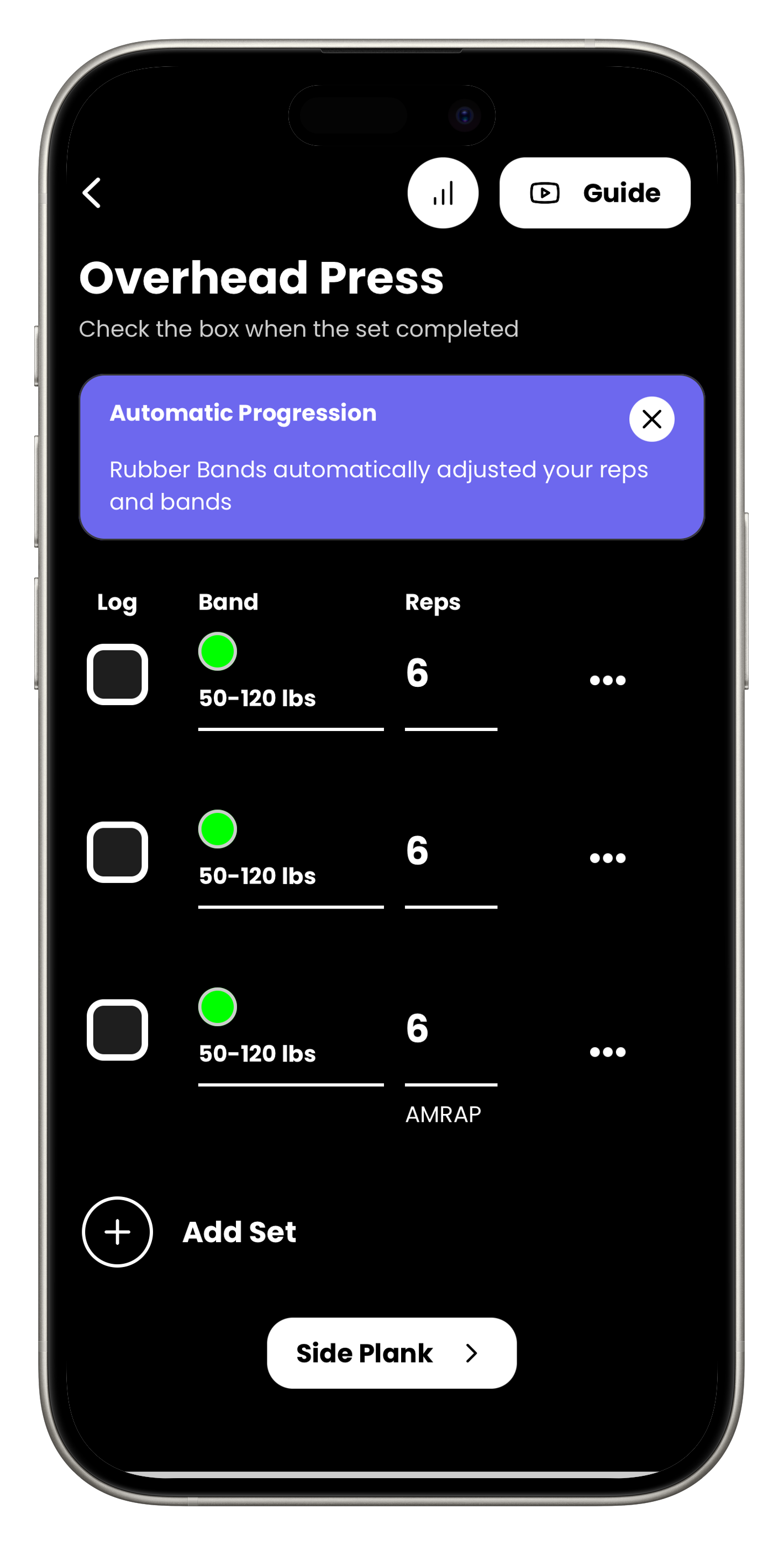
The Complete Progression Flow
Here's what happens when you complete a workout:
- Workout Completion: Your sets, reps, and bands are logged
- History Analysis: The system reviews your performance for each exercise
- Next Workout Generation: When you start your next workout:
- Reps are calculated based on your historical performance
- If you've exceeded optimal volume, bands that increase tension are automatically selected
- Reps are adjusted proportionally to the resistance increase
- Everything stays within your fitness goal's optimal range
Conclusion
By automatically tracking your performance and intelligently recommending when and how to increase difficulty, the app ensures you're always making progress toward your fitness goals. Whether you're building strength, muscle, or endurance, the system adapts to keep you challenged and progressing safely.
The beauty of this system is that it works silently in the background. You just show up, follow the recommendations, and watch your strength grow workout after workout.