
X3 vs. Clench Bar: Why I Own Both
The X3 is my favorite bar for almost everything. The Clench Carbon Pro is the only one I trust for the chest press. Here is the nylon-versus-bearings trade-off behind that.

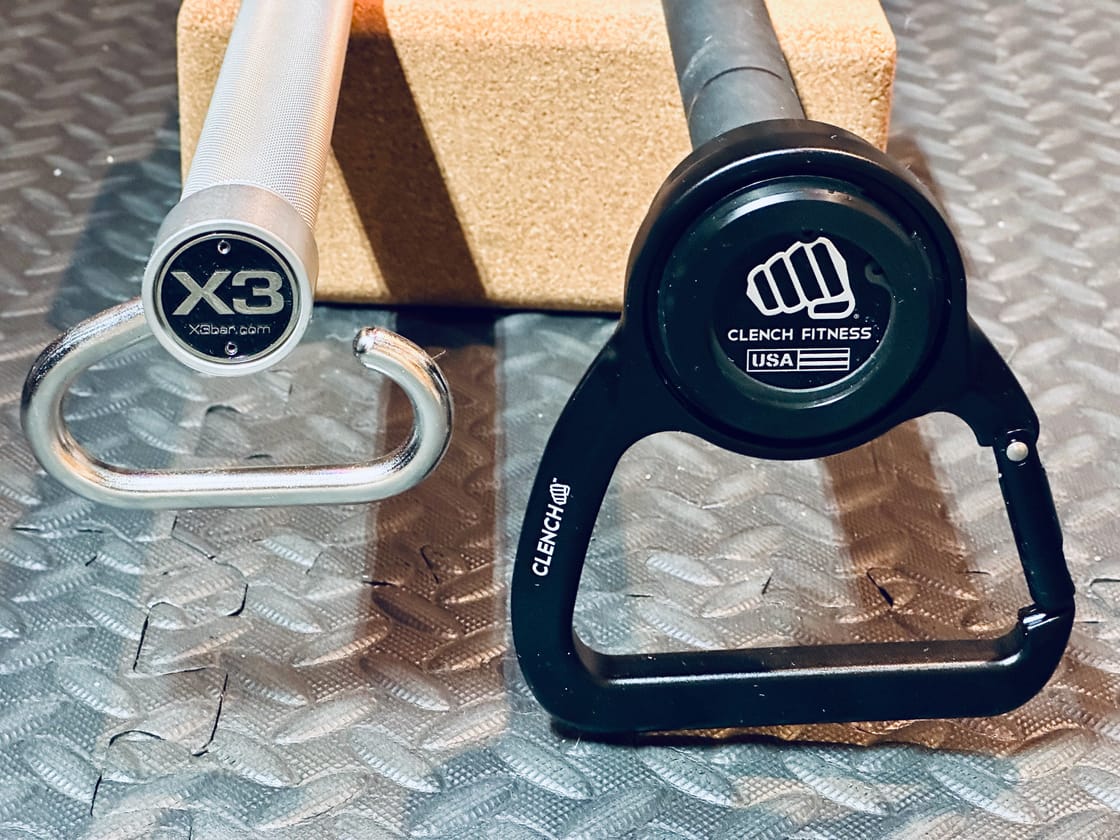
I own two resistance band bars that do basically the same job, and I use both of them every week. Not because I cannot make up my mind. It is because three times now, one of these bars has shot out of my hands and hit me in the chest. The other one fixed that exact problem, and created a new headache of its own.
If you train with bands and a bar, this trade-off is the thing not many people talk about. So here is the whole story: a little history, the specs, the one movement that changed how I train, and why both bars still earn a spot in my gym.
A brief X3 history
If you already know the X3® story, skip ahead.
The X3 Bar was invented by Dr. John Jaquish following his earlier work on bone density. The story begins with his mother's osteoporosis diagnosis, which led him to develop OsteoStrong, a medical device to improve bone health. While researching human physiology for that project, he found that people are significantly stronger in certain ranges of motion, up to seven times stronger in their "impact-ready" positions than in their weaker, joint-compromised positions. On a bench press, for example, you are far stronger near lockout than when the bar is closest to your chest.
Resistance bands offer linear variable resistance, which better matches that strength curve. The X3 bar was built to take advantage of it, and it launched the whole category of heavy band-and-bar training that Clench® and others now compete in.
The two bars
The X3 Bar is short, spins on nylon bushings, and uses hooks on the ends. It is the one a lot of you already own.
The Clench Carbon Pro is longer, runs on bearings, and uses carabiners instead of hooks.
On paper they are the same product. In practice, the way each one handles load is completely different, and that difference is the entire reason I run both.
| Specification | X3 Bar (Elite) | Clench Carbon Pro |
|---|---|---|
| Bar material | Machined anodized aluminum with steel center shaft | Carbon fiber with steel end caps |
| Bar length | 21.5 in (standard) or 29.5 in (long bar) | 36 in |
| Bar weight | 4 lb (1.8 kg) | About 2.5 lb (1.13 kg) |
| Rotation | Nylon bushings | Ball bearings |
| Band attachment | Hooks | Carabiners |
| Max load | 600+ lb | 1000 lb |
| Best at | Speed. Every movement except the chest press | Smooth, predictable rotation under heavy load |
| Weak spot | Bushings can stick and snap free when the load is out in front | Carabiners are slow and fiddly every set |
The problem: the X3 chest press
For about 95 percent of my movements, the X3 is my favorite bar, period. Rows, deadlifts, curls, even overhead press. Flawless.
There is exactly one movement where I will not use it anymore: the chest press.
Think about where the bar sits in a chest press. It is pushed straight out, away from your body. Your arms are extended, the load is out in front of you, and you have the least leverage you will ever have to correct anything. It is the most exposed position in the whole workout.
Now the issue. The X3 spins on nylon bushings. Under really heavy tension, those bushings do not rotate smoothly. They stick, and then they suddenly let go. If you press slowly with a heavy band, you can hear it: a little creak as the nylon switches from static friction to kinetic friction.
When that happens with the bar already out in front of you, the sudden release throws the bar off line. Your wrist rolls, and you lose the whole thing. This has happened to me three times. And before anyone says "skill issue," it has happened to people who are more than strong enough to handle that tension. It is not about being strong enough. It is about the bar doing something unpredictable at the worst possible moment. The problem gets worse as tension goes up, and for me it shows up almost exclusively with the Elite band.
Here is the interesting part: the overhead press does not do this. Same bar, same heavy bands. The difference is that overhead, the load is stacked vertically over you and your arms brace the band from the sides. It is stable. The chest press is the only movement where the bar is hung out horizontally in a position you cannot easily save. That is what makes it the one exception.
Why this does not happen with a barbell
Somebody is going to ask: "I bench with a regular barbell all the time. Why isn't this a problem there?"
One word: mass.
A loaded barbell has real, physical weight, and weight means inertia. The bar does not want to move. It stabilizes itself just by being heavy.
Bands have none of that. A bar with bands on it is basically weightless until you load the bands, so there is no inertia to absorb anything. When the bushings stick and snap free, nothing slows that release down. It is not falling. It is firing. You have a slingshot pointed at your chest, and when it lets go, it lets go faster than gravity. That is why it feels like nothing you have experienced with iron.
Why nylon gives way
No engineering degree required for this one.
A nylon bushing is a sleeve the bar slides around inside. It works on sliding friction: two surfaces dragging against each other. Picture shoving a heavy box across the floor. It does not glide. It resists, resists, then suddenly breaks loose and skids. The heavier the box, the more violent that break. That is exactly what nylon does under heavy band tension. Grip, then sudden slip.
A bearing is the opposite. Instead of dragging, it rolls. Same heavy box, now on wheels. It moves smoothly and consistently no matter how much weight is on it. No grip, no sudden release, no lurch.
That is the entire difference. Nylon sticks and snaps free under load. Bearings roll. In a position where a small lurch means losing the bar, that is everything. You can still see tiny movements during a press on bearings, but your wrist is far better at correcting a smooth movement than a sudden one.
The Clench Carbon Pro
Which brings me to the Carbon Pro. This is the bar I press with now, specifically because it runs on bearings. Same heavy band, same slow press, and it is quiet and smooth the whole way through. No stick. No lurch. I can push out in front of me and trust it.
You might look at the two and think the band tension must be completely different, since the Clench is so much longer. Here is the neat part: yes, it is a longer bar, but the carabiners on it are also bigger. The bands hook on further out, which effectively shortens the working distance. So even though the X3 is the shorter bar, the tension you actually feel lands very close between the two. They are far more comparable than they look side by side.
So why not use the Clench for everything?
If the Clench is smooth and it solved my chest press problem, why not retire the X3?
One word: carabiners.
The Carbon Pro is a genuinely great bar, but the carabiners drive me up the wall. This is not a Clench-specific complaint. It is every band bar that connects with carabiners. Swapping bands, clipping, unclipping, fighting the gate, dragging the band over the edges. It is fiddly, every set.
Compare that to the X3 hooks. On, off, done. It is instant. Setup speed on the X3 is unmatched, and the bands never fall out because of how the hooks are shaped. If you have any hand issues, arthritis, grip strength, anything like that, dealing with carabiners every set is a real pain. The X3 hooks are an accessibility win that nobody talks about.
So that is the catch-22. The Clench is safer for pressing but slower to use. The X3 is faster to use, but I cannot trust it for pressing.
The verdict
Both bars are great. If you made me pick the best overall bar, it is the X3, and it is not particularly close. I love the length. The hooks are the fastest setup on the market. It is the right bar for almost every movement I do.
The only thing holding it back is the nylon bushings on the chest press. I will say this plainly: if the X3 shipped with bearings, it would be in a tier of its own, and it would be the only bar I own.
Until that day, this is my actual setup. X3 for everything, and the Clench Carbon Pro for chest press. Two different bars, both earning their spot for two completely different reasons: speed everywhere, and a bearing I can trust when the load is out in front of me. I leave the same bands on the Clench permanently, since the chest press is the only movement I do with it, which also neatly sidesteps the carabiner problem.
If you are shopping for a band bar, that is the trade-off in a nutshell: hooks and speed versus bearings and smoothness. Now you know what to actually look for.
One safety note: if you press heavy with any band bar, keep the bar close, build up tension gradually, and stop the set the moment the rotation feels like it is catching. A band bar that lets go does so fast.
